
The AI Governance Gap
Artificial intelligence is becoming embedded in how organizations make decisions, conduct research, and deliver services.
But across sectors, a consistent pattern is emerging:
AI capability is advancing faster than the systems designed to govern it.
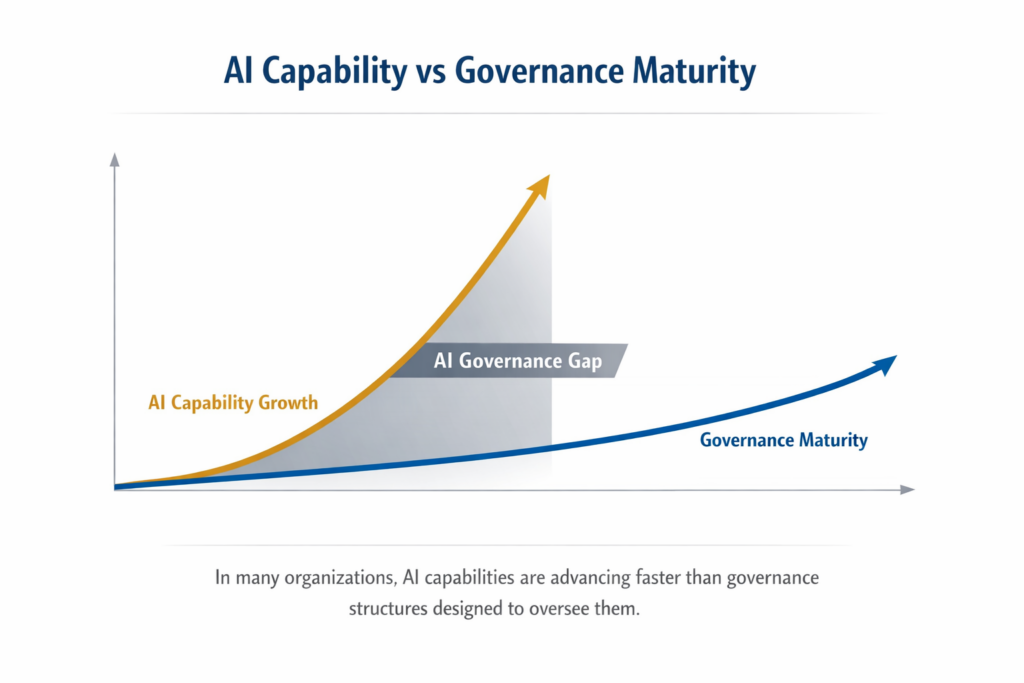
That gap is rarely visible at the surface.
Governance frameworks exist. Policies are defined. Oversight roles are assigned.
Yet in practice:
- leadership often lacks visibility into how AI systems influence critical decisions
- accountability becomes difficult to trace once decisions are automated
- governance structures do not keep pace with how systems actually operate
- risk accumulates across technical, organizational, and regulatory dimensions
By the time these gaps become visible, the consequences are already in motion.
This is the AI Governance Gap—and most organizations are already operating within it.
What this means for leadership
The challenge is not simply adopting AI responsibly.
It is determining whether existing governance assumptions still hold under real operating conditions.
Most organizations are not underprepared.
They are operating on a model of governance that no longer reflects how decisions are being made.
WHERE LEGACYNOVA OPERATES
LegacyNova works with executives and boards at the point where this gap becomes decision-relevant.
Not to build governance systems.
But to assess whether those systems will hold.
This includes:
- identifying where governance maturity is overestimated
- interpreting regulatory and institutional signals in context
- evaluating decision pathways before they are locked in
- surfacing risk that is not yet visible within internal structures
ABOUT THE GOVERNANCE MODEL
LegacyNova’s governance model reflects recurring patterns observed across complex institutions.
Rather than a framework to implement, it serves as a lens for leadership teams to evaluate:
- where oversight is assumed but not functioning in practice
- where accountability is unclear across systems and teams
- where governance structures do not align with how decisions are actually made
Key areas of focus include:
Leadership Oversight
Where responsibility for AI-driven decisions is defined—but not always exercised.
Transparency and Accountability
Where organizations assume visibility into systems that are increasingly opaque.
Risk and Institutional Integrity
Where exposure accumulates across technical systems, organizational behavior, and regulatory expectations.
Responsible Innovation
Where pressure to move forward outpaces the ability to govern effectively.
LegacyNova is typically engaged when leadership needs a clearer view of governance, risk, and decision-making—before those issues become visible under external scrutiny or internal failure.